
How to Choose the Right Smartphone: Complete Buying Guide
9/3/2026
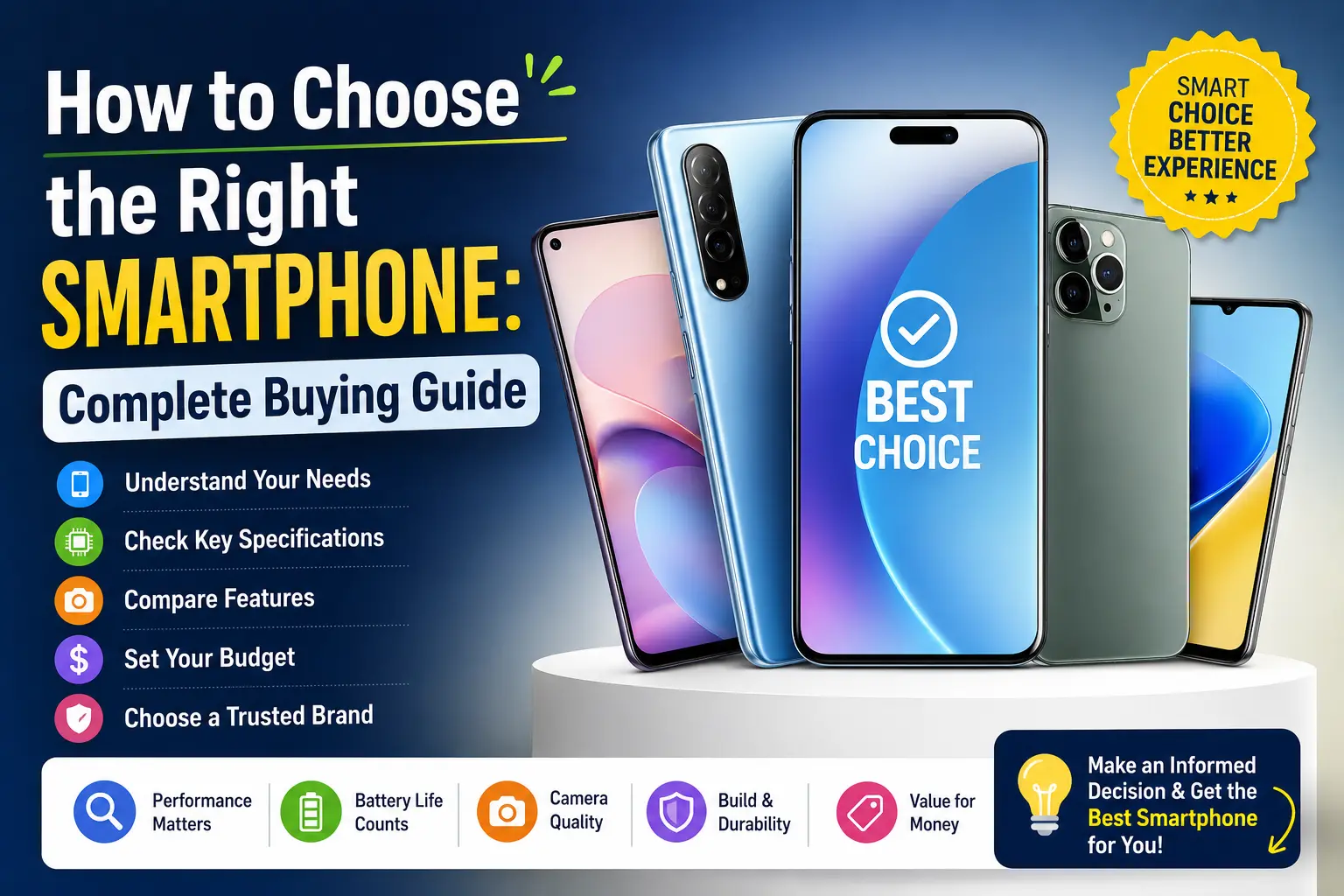
Confused about how to choose the right smartphone? This complete buying guide breaks down budget, camera, battery, display, and performance in simple terms.
Introduction
Buying a new smartphone can feel overwhelming. Brands release dozens of models every year, each claiming to have the best camera, the fastest processor, or the longest battery life. With so many options and marketing terms thrown around, it's easy to get confused about what actually matters. This guide walks you through every important factor step by step, so you can choose a smartphone that genuinely fits your needs and budget, not just one with an impressive spec sheet.
Step 1: Set Your Budget First
Before comparing features, decide how much you're willing to spend. Smartphones generally fall into three categories: budget phones, mid-range phones, and premium flagship phones. Budget phones focus on essential functionality at the lowest cost. Mid-range phones balance price and performance, often offering nearly flagship-level features for less money. Premium flagships include the latest chipsets, best cameras, and most advanced displays, but come at a significantly higher price. Setting a clear budget first narrows your choices and prevents overspending on features you may never use.
Step 2: Decide What You'll Use the Phone For
Your daily habits should shape your decision more than marketing hype. Someone who mainly uses a phone for calls, messaging, and browsing has very different needs from a mobile gamer or a content creator who shoots videos for social media. Think honestly about how you'll use your phone most: everyday communication, gaming, photography, business use, or heavy multitasking. This single decision will guide almost every other choice you make in this guide.
Step 3: Understand the Display
The display is what you interact with the most, so it deserves careful attention. Smartphones typically use either OLED/AMOLED panels or LCD panels. OLED and AMOLED displays offer deep blacks, vivid colors, and better contrast, making them ideal for watching videos and viewing photos. LCD displays are usually more affordable and still deliver solid everyday performance, though colors and blacks aren't quite as rich. Refresh rate is another factor worth considering; a 90Hz or 120Hz display feels noticeably smoother when scrolling or gaming compared to a standard 60Hz screen, though it can use more battery. Screen size and resolution also affect comfort, especially for reading, browsing, or watching content.
Step 4: Evaluate the Processor and Performance
The processor, or chipset, determines how smoothly your phone runs apps, games, and multitasking tasks. Flagship chipsets deliver the fastest performance and best future-proofing, but mid-range chipsets are often more than enough for everyday tasks like browsing, messaging, and casual gaming. If you plan to play graphically demanding games or run heavy apps, prioritize a phone with a stronger processor and sufficient RAM, ideally 8GB or higher for smooth multitasking.
Step 5: Consider Storage Needs
Storage affects how many photos, videos, apps, and files you can keep on your device. Casual users who rely on cloud storage may be comfortable with 64GB or 128GB, while people who take lots of photos, record videos, or install many apps and games should consider 256GB or more. Some phones offer expandable storage through a microSD card, which can be useful if you want flexibility without paying extra for a higher storage tier upfront.
Step 6: Assess the Camera System
Camera quality matters differently to different people. If photography or social media content creation is a priority, look closely at the main sensor's megapixel count, aperture size, and additional lenses such as ultra-wide or telephoto. However, megapixels alone don't guarantee great photos; software processing, low-light performance, and stabilization features often matter more in real-world results. For casual users who mainly take everyday photos, a reliable mid-range camera setup is usually sufficient.
Step 7: Check Battery Life and Charging Speed
Battery capacity, measured in mAh, gives a general idea of how long a phone can last, but actual battery life also depends on the display, processor efficiency, and how the phone is used. If all-day battery life is important to you, look for phones with larger batteries and efficient chipsets. Charging speed is equally important; fast charging technology can top up a phone significantly in a short amount of time, which is especially useful for people with busy schedules.
Step 8: Think About Software and Updates
The operating system and how long a manufacturer supports it with updates can affect your phone's lifespan and security. Phones that receive regular software and security updates tend to stay smoother and safer for longer. If you plan to keep your phone for several years, check the manufacturer's update policy before buying.
Step 9: Build Quality and Design
Build quality affects durability and daily comfort. Metal and glass frames tend to feel more premium but can be heavier and more slippery, while plastic-bodied phones are often lighter and more affordable. Features like water and dust resistance (IP ratings) can also be valuable if you're prone to accidents or live in a humid climate.
Step 10: Compare Prices and Read Reviews
Once you've narrowed down your options based on the factors above, compare prices across trusted retailers and read reviews from reputable technology publications and verified buyers. Reviews often reveal real-world performance issues or strengths that spec sheets don't show, such as camera consistency, software bugs, or long-term reliability.
Quick Buying Guide by User Type
-Everyday users: Prioritize a reliable mid-range phone with a good display and solid battery life.
-Gamers: Focus on a powerful processor, high refresh rate display, and efficient cooling.
-Photographers/content creators: Prioritize camera versatility, video capabilities, and storage.
-Business users: Look for strong battery life, software longevity, and comfortable one-handed use.
-Budget-conscious buyers: Focus on essential performance, decent camera, and dependable battery rather than premium extras.
Frequently Asked Questions
What is the most important factor when buying a smartphone? There's no single most important factor — it depends on your personal use case. For most people, a balance of display quality, battery life, and performance matters more than any one spec alone.
Is a higher megapixel camera always better? No. Image processing, lens quality, and software play a bigger role in photo quality than megapixel count alone.
Do I need a 120Hz display? Not necessarily. It makes scrolling and gaming feel smoother, but it isn't essential for basic phone use and can reduce battery life.
How much RAM do I need? 6GB is generally sufficient for basic use, while 8GB or more is recommended for smoother multitasking and gaming.
Should I buy the newest flagship or a mid-range phone? If budget allows and you want the latest features, a flagship is a safe long-term choice. Otherwise, a well-reviewed mid-range phone often delivers excellent value.
Conclusion
Choosing the right smartphone comes down to understanding your own needs rather than chasing every trending feature. Set a budget, identify your primary use case, and prioritize the display, processor, camera, and battery features that matter most to you. By following this structured approach, you can confidently choose a smartphone that offers real value and long-term satisfaction, rather than one you regret a few months later.
Comments (0)
Related news
 Samsung and Duolingo Mock Apple iPhone Duo LaunchSamsung and Duolingo went viral on X after mocking Apple's new $1,999 iPhone Duo foldable, poking fun at its name, hardware features, and late market entry.9/12/2026
 iPhone Duo vs Galaxy Z Fold 8 - World smartphoneCompare Apple's new iPhone Duo and Samsung's Galaxy Z Fold 8 across display technology, hardware dimensions, cameras, charging speeds, and prices.9/11/2026
 Apple Unveils iPhone Duo: Its First Foldable SmartphoneApple announces the foldable iPhone Duo, featuring a 7.6-inch flexible display, vapor-cooled A20 Pro silicon, 48MP dual cameras, and iOS 27 multitasking.9/10/2026